Sovereign industrial software for European defence manufacturing and logistics
A software platform for European defence manufacturers addressing procurement, compliance, and supply chain challenges with European data sovereignty.
The Problem We Are Solving
Through structured market validation, we have identified a critical gap: European defence supply chains are fragmented across borders, regulatory regimes, and legacy systems. Manufacturers lack modern, sovereign software infrastructure as defence spending accelerates and compliance demands intensify.
Fragmented tooling
Defence manufacturers rely on Excel spreadsheets, email chains, and manual workflows for critical procurement and production tracking.
US SaaS dependency
Existing software comes from US vendors subject to CLOUD Act and extraterritorial jurisdiction, creating sovereignty risks for European defence data.
Long procurement cycles
Defence contracts span years with strict documentation, traceability, and export control requirements that generic ERP systems cannot handle.
Supply chain opacity
Multi-tier supplier networks lack visibility, making it difficult to prove compliance, track component origin, or manage dual-use regulations.
Strategic Context
The European Defence Industrial Strategy and EDF initiatives are driving cooperation across member states. As industrial policy evolves toward strategic autonomy, software infrastructure must align with the same sovereignty principles now applied to hardware, components, and supply chains.
What We Are Building
We are designing an integrated software platform for production tracking, compliance management, and supply chain coordination, purpose-built for the European defence manufacturing ecosystem.
From the ground up, we are architecting for European jurisdiction, auditability, and alignment with GDPR, NIS2, dual-use regulations, and export control frameworks. Infrastructure that can be inspected, verified, and trusted.
View our software architecture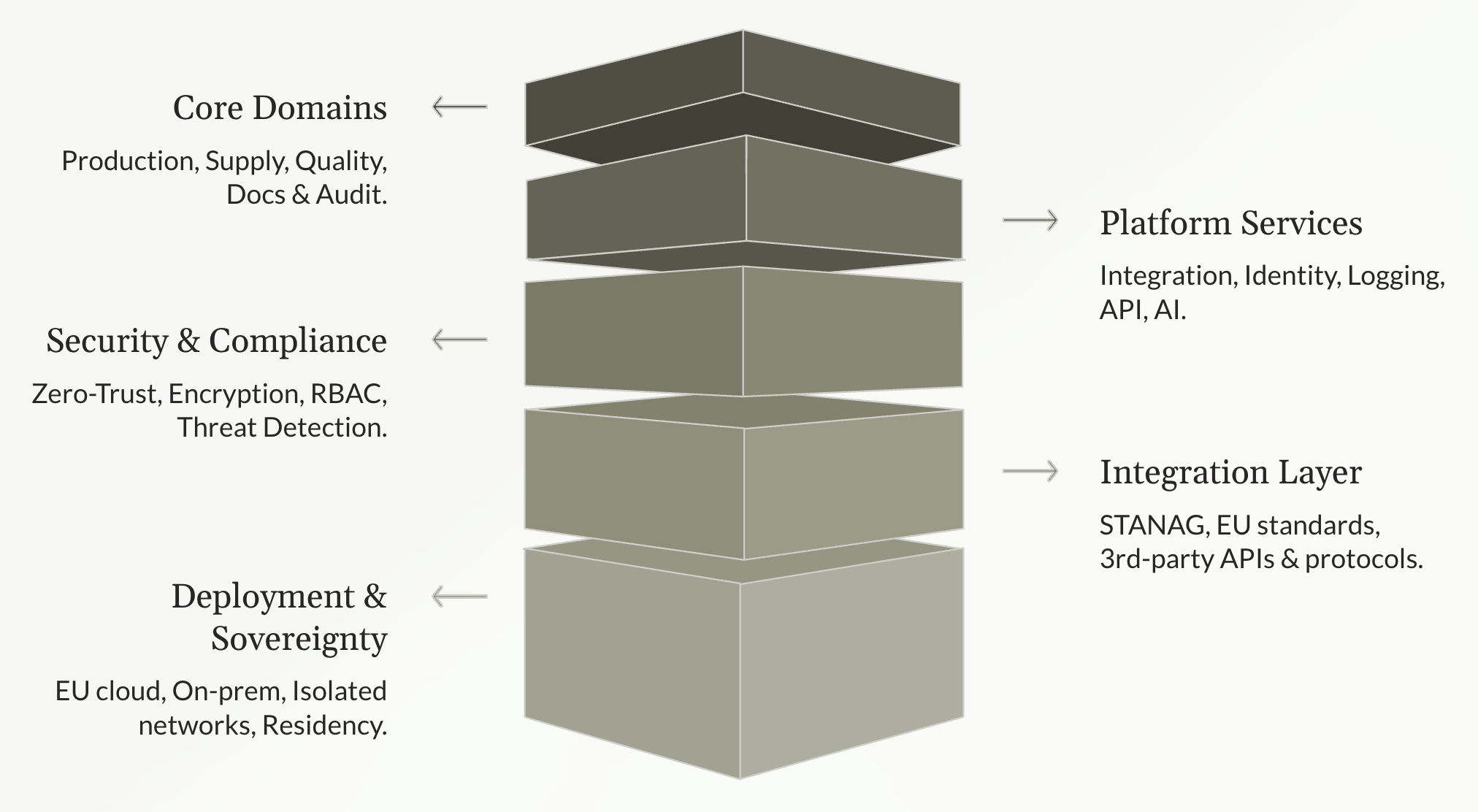
Areas of Focus
Production & Compliance
Real-time manufacturing tracking with automated documentation and audit trails
Inventory & Procurement
Supplier qualification, lot tracking, and serialisation for component-level traceability
AI Enablement
Planning support, compliance document parsing, and anomaly detection with human-in-the-loop decisions
Cyber Security
Defence-grade access control, zero-trust architecture, and encryption at rest and in transit
Quality & Traceability
Component-level traceability aligned with defence standards and certification requirements
Cross-Border Operations
Secure multi-site collaboration with export licence and end-user certificate management
Where We Stand
From concept to architecture to product preview in weeks. Moving at startup speed with enterprise-grade rigour.

Architecture defined
Core software engineering architecture has taken its first clear form, laying the foundation for a modular, sovereign platform.
Team expanding
Growing beyond engineering with our first compliance hire, bringing banking, Amazon regulatory, and MBA experience to build defence-grade governance from day one.
Early product preview
An early interactive preview is available for stakeholder feedback, demonstrating our platform direction and validating core workflows before MVP development.
Execution Plan
A phased plan focused on building the right product for the right market. Each phase is designed to de-risk the next, building credibility through execution rather than assumptions.
Validation & Seed Funding
- Seed funding to accelerate engineering, compliance, and go-to-market
- Structured problem and market validation with defence industry stakeholders
- Internal compliance framework development
- Company incorporation in the EU
MVP & First Design Partners
- MVP development: production tracking, compliance management, core workflows
- Onboard 2-3 design partners from defence manufacturing for co-development
- Begin certification pathway assessment (EU/NATO ecosystem)
Controlled Pilots
- Deploy with design partners in controlled pilot environments
- Iterative development based on real-world feedback
- Compliance validation with regulatory advisors
- Grow engineering team for platform hardening
Early Traction
- First paid engagements with pilot-validated SME partners
- Apply to EU defence innovation and funding programmes (EDF, EDIP)
- Build pipeline through defence industry events and ecosystem engagement
About Us
A focused team combining 16+ years of engineering excellence with regulatory expertise, committed to building sovereign defence software that meets European standards from day one.

CEO, Co-Founder
Senior software engineer with 10+ years building advanced frontend and user-centric systems. Experienced in leading engineering teams across international environments. Focused on user experience, secure interfaces, and operational tooling for mission-critical defence applications.

CTO, Co-Founder
Senior software engineer specialising in distributed systems and high-reliability backend architecture. Experienced in designing and scaling infrastructure for mission-critical services, bringing expertise in resilient systems, data pipelines, and security-focused backend engineering for defence-grade software platforms.

Chief Compliance Officer
Compliance and regulatory leader with 15+ years across banking and federal systems. Expert in regulatory frameworks, data sovereignty, and export controls, with proven success managing large-scale compliant software programs. Delivers platforms meeting security, audit, and traceability requirements across international jurisdictions.
Between us, we have deep experience building large-scale manufacturing and warehouse software systems— handling inventory management, production workflows, traceability, and compliance for complex global supply chains. We understand the technical challenges of secure, auditable systems in regulated environments.
What We Bring
Market & Timing
European defence is entering its largest structural shift in decades. Our validation confirms a clear and growing need for sovereign software infrastructure purpose-built for this ecosystem.
EUR 381B+
EU Defence Spending
2025, growing annually
EUR 800B
Projected by 2030
European defence budgets
9%
Annual Growth Rate
Defence spending trajectory
27
EU Member States
Requiring compliant software
Defence spending growth
European defence budgets are increasing as member states respond to security threats and commit to higher spending targets, creating momentum for industrial modernisation.
Digital infrastructure gap
Thousands of European defence manufacturers still rely on legacy ERP systems that are expensive, inflexible, and often hosted outside EU jurisdiction.
Sovereignty requirements
European defence policy increasingly emphasises strategic autonomy and supply chain resilience. This extends beyond components and hardware to the digital infrastructure that manages them.
Partner With Us
View PresentationWe are building DefenceOS to become the operational backbone for European defence manufacturing. We are seeking strategic partners, investors, and industry collaborators who share our commitment to sovereign, compliant infrastructure for European defence.
Investors
Pre-Seed and Seed
OEMs & Primes
Integration partners
Suppliers
Tier 1-3 manufacturers
Advisors
Defence and regulatory